Edirne, spring 1717. Lady Mary Wortley Montagu, wife of the British ambassador in Istanbul, is one of the first European women to describe the world of Ottoman women from the inside. In a letter dated 1 April, she writes that Turkish women have "the most beautiful complexion in the world". She describes their large black eyes, their thick hair divided into countless tresses and their rose-colored nails.
More than a hundred years later, Julia Pardoe, who came to Istanbul in 1836, notices the same thing and traces this complexion back to a single habit: the hammam.
At Modalco, we have named this series Saray Defteri (The Palace Notebook). In it, we explore the beauty ideals and care traditions of women in the Ottoman palace and its konaks, the grand mansions of the city, drawing on period sources. We share information backed by sources, not legends. At the end of each section, you will also find the modern-day equivalent of that tradition.
The place we call the palace
In the Ottoman world, the word "palace" first brings Topkapı to mind. In the Harem section of the palace lived the Valide Sultan, mother of the padishah, along with the women of the dynasty and the hundreds of women in their service. The women of the dynasty bore the title "Sultan", and in this series the word "sultans" refers to them.
The palace's beauty culture did not stay within its walls. Women who left the palace to marry went on living in Istanbul and kept their ties with the palace. That is why palace and konak traditions are often told together.
A dictionary of beauty: "beautiful" in divan poetry
Nothing captures the Ottoman ideal of beauty better than divan poetry. Poets portray the beloved again and again with the same images:
- A figure like a cypress, a face like the moon, the sun or a candle.
- Cheeks of rose and tulip, brows like a crescent or a bow, lashes like an arrow.
- Eyes like a narcissus or an almond, lips of ruby and sugar, a mouth like a rosebud, teeth of pearl.
- Skin of silver and crystal, a throat as bright as a mirror, hair as black as night and scented with hyacinth.
Nedîm describes the beloved as "like a rose, like crystal". Translate these images into today's language of skincare, and a familiar list appears:
| In poetry | What it means | Today's step | At Modalco |
|---|---|---|---|
| Moon face, crystal skin | A bright, smooth complexion | Brightening hydration, a weekly mask | Garnier Vitamin C Fresh & Bright, On Arbutin Mask |
| Rose and tulip cheeks | A lively, warm color on the cheeks | A light touch of color | Tinted lip care balm with a blush effect (for lips and cheeks) |
| Arrow lashes | Long, defined lashes | Mascara | L'Oréal Telescopic Gold, Panorama |
| Narcissus and almond eyes | A bright, rested look | Eye-area care | Luminous630 eye cream, Retino-peptide eye patch |
| Ruby lips, rosebud mouth | Red, full lips | Lip care | Blackberry lip care balm, Mjcare Eye and Lip Care Set |
| A silver throat | A cared-for, glowing neck | Extend your moisturizer down to your neck | Garnier Hyaluron Fresh & Plump |
Through Lady Mary's mirror: beauty in 1717
Lady Mary's letter of 1 April 1717 shows what the poetic ideal looked like in everyday life:
- Hair: Women let their hair grow to its full length and wear it hanging down their backs in countless tresses braided with pearls or ribbons. In one lady's hair, Lady Mary counts 110 tresses and notes that all of them were natural.
- Jewels: On one side of the head, a bouquet of jewels made to resemble real flowers is worn. The buds are pearls, the roses rubies, the jasmines diamonds, the jonquils topazes.
- Brows and eyes: Eyebrows are shaped, and a black tincture is applied around the eyes. Lady Mary writes that from a distance or by candlelight this tincture makes the eyes look even darker, but that by day it is too visible.
- Nails: Nails are dyed a rose color. Lady Mary makes no secret of the fact that she could not get used to this fashion.
Today's lesson: Lady Mary's distinction between day and evening still holds today. By day, a light coat of mascara is enough; in the evening light, more defined lashes suit the "arrow lashes" of poetry.
1. The hammam: the great weekly ritual
At Topkapı, the hammam is as old as the palace itself. A 2017 restoration uncovered a bath dating to the 1460s that had been used by five padishahs. Mimar Sinan built the Hünkâr Bath, the padishah's own bath, in the 1580s. Today, visitors to the Harem can still see the Hünkâr and Valide Sultan baths.
According to Lady Mary, women go to the hammam once a week and stay there for four or five hours. They pass from the hot room into the cool room without catching a chill. In 1836, in the konak where Pardoe was a guest, the lady of the house went from her bed to the hammam every morning and did not come out in less than two hours.
Women went to the hammam carrying an embroidered bundle, the bohça. Inside were a peshtemal (bath wrap), a loofah, a kese (exfoliating mitt), towels, soap, henna, a hammam bowl, a comb, a mirror and clean clothes. Pardoe also describes how, after the bath, hair was tied up in embroidered handkerchiefs.
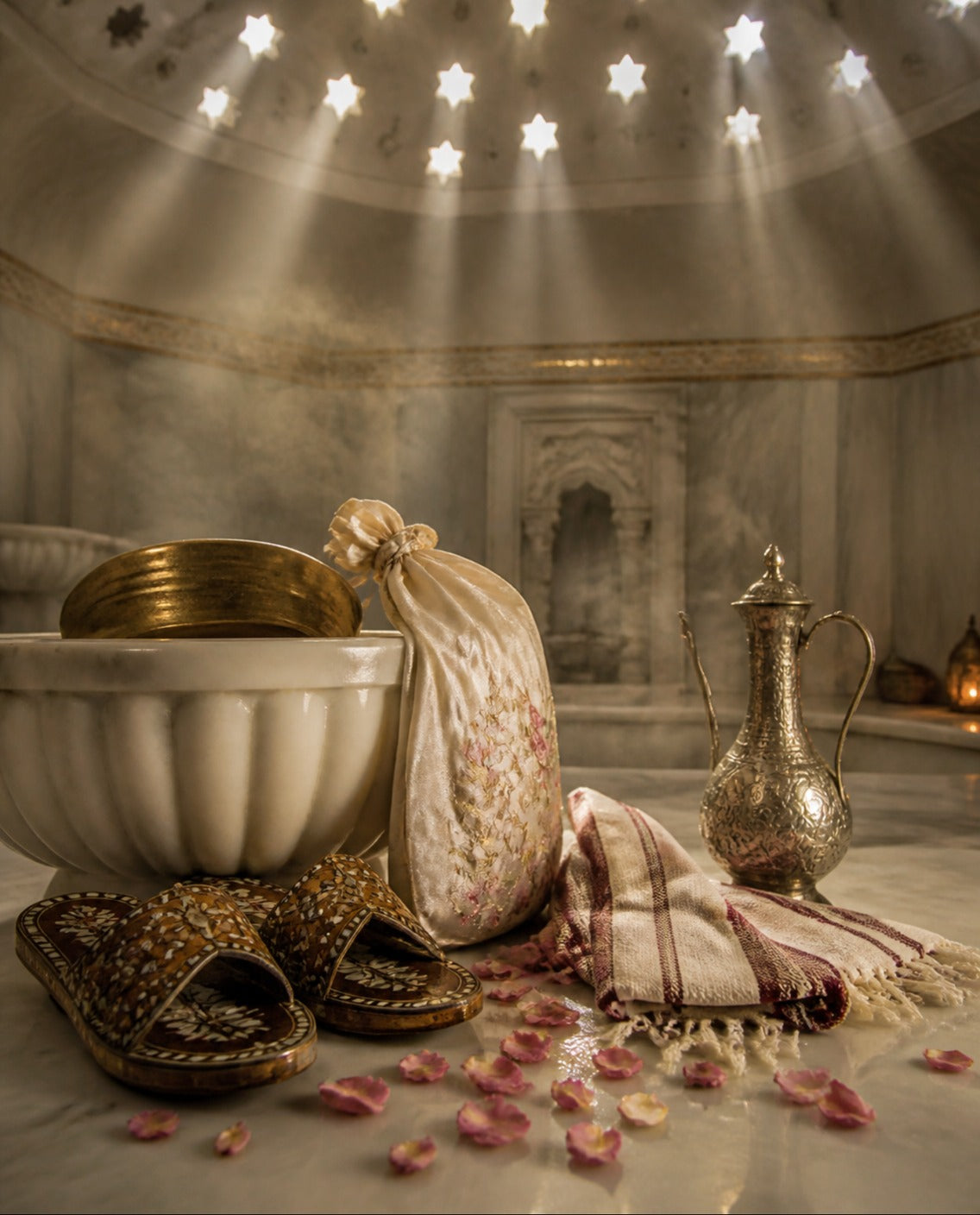
Practical note: The order of the hammam is still the same today. First you sweat in the heat and your skin softens, then comes the kese scrub, and finally you cool down and rest. Pardoe adds a warning: going to the hammam this often wears out the hair, and some women resort to false braids. In beauty care, too, everything is best in moderation.
Today's equivalent: At home, the order of the hammam stays the same. A warm shower softens your skin; then, once or twice a week, on an evening you set aside for yourself, you exfoliate gently. Modalco's Peeling Trio brings a face pad, a hand mask and a foot mask together in one pack: the modern version of the kese in the bundle. If you want to reduce chlorine and limescale in your shower water, the Shower Care Set comes with the Madeca shower filter.
2. The rose: its water, its oil, its scent
The palace used large quantities of rosewater and rose oil. According to medical historian Prof. Dr. Ayten Altıntaş, part of this demand was met by the rose gardens of Edirne. Evliya Çelebi writes that women from Edirne sold rosewater in copper vessels at the Egyptian Bazaar (Mısır Çarşısı) in Istanbul.
Pardoe describes rose oil being sold in Istanbul's perfume bazaar in small, gilded, tightly wrapped bottles. She also writes that a rose-scented sherbet served at a konak dinner filled the whole room with its fragrance. The "rosy cheek" of poetry is no accident: the rose is both the color and the scent of this world.
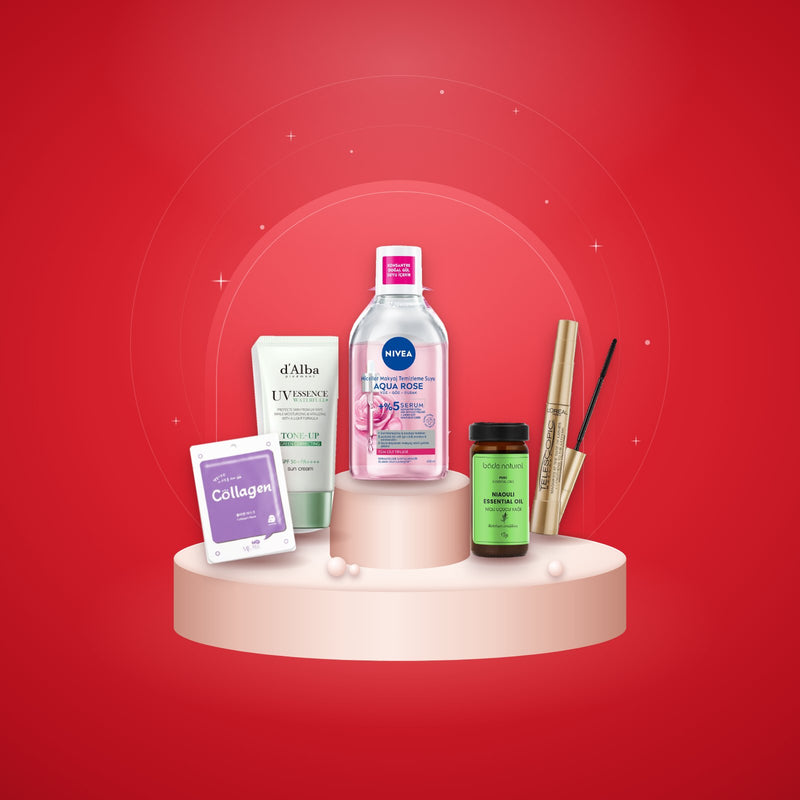
Today's equivalent: Today, rosewater's role is cleansing and freshness. At the end of the day, as you remove your makeup and the day's impurities, you can build this step with NIVEA Aqua Rose: a two-phase micellar water with rose water. If your skin is sensitive, Garnier Micellar is a lovely alternative too.
3. Kohl (sürme) and lashes
The black tincture Lady Mary describes is called sürme, a type of kohl. Sürme is a cosmetic, mostly black, used to line the eyelids and the roots of the lashes. It is made from antimony-based ismid or from soot; it is taken from a kohl pot and applied with a slender stick called a mil.

Safety note: Chemical analyses report high levels of lead in most commercial kohl products. We recommend continuing this tradition today with tested products. For the "arrow lashes" of poetry, Modalco's L'Oréal Telescopic Gold adds length to your lashes and Panorama adds volume. For "narcissus eyes", Luminous630 gives the area around your eyes attentive care.
4. Henna, brows and lips
Henna was part of the hammam bundle, and folk poems often praise hennaed hands. For the brows, Pardoe describes a method: an elderly lady burns a hazelnut in a candle flame to obtain an oily black soot, dyes her eyebrows with it and joins them above her nose. The "crescent brow" ideal of an earlier age may surprise us today.
Today's equivalent: For "ruby lips" and "rosy cheeks", a single product is enough: Modalco's tinted lip care balm with a blush effect can be used on both your lips and your cheeks and contains SPF30. And today's version of the care once given to hennaed hands is a hand peeling mask.
5. The ferace and the yashmak
According to Lady Mary, women go out into the street wearing a yashmak made of two veils and a long ferace, an outer robe. This covering gives them the freedom to conceal their identity. In Lady Mary's letters, these women are described as "the only free people in the empire".
Today's equivalent: The ferace and yashmak were garments, but they also covered the face outdoors. Today, the step that protects your face outdoors is the sunscreen you apply in the morning before leaving the house. At Modalco, UV Waterfull Tone-up sun cream protects your skin while making your skin tone look more even. If your skin is dry and you love almond oil, the SPF15 nourishing day cream is a lovely option too.
6. A documented warning: the balm of Mecca
Lady Mary goes to great trouble to find the balm of Mecca praised by Turkish ladies and applies it to her face. The next morning her face is swollen and red, and it stays that way for three days. In her letter of 17 June 1717, she writes that she no longer trusts products of this kind that promise wonders.
Today's lesson: Try a new product on a small area first, and choose what suits your skin. That is why Modalco's 2-minute Skin Test exists: it asks about your sensitivities and keeps ingredients that don't suit you out of your routine.
Myths and facts
- Milk bath: A legend usually told with reference to Cleopatra. There is no document linking it to the Ottoman palace.
- Mesir paste: A traditional remedy paste made with 41 spices. According to legend, it helped Hafsa Sultan, mother of Suleiman the Magnificent, feel better. It is not a cosmetic.
- "The sultan's daily routine": No step-by-step beauty routine of any particular sultan has been documented. The routine we suggest is a modern interpretation inspired by this tradition.
Today's equivalent: palace care in 5 steps
- Cleanse (rosewater): Remove your makeup and the day's impurities with NIVEA Aqua Rose.
- Kese day (hammam): 1–2 times a week, bring the hammam's kese ritual home with the Peeling Trio.
- Refresh (the hammam's cool room): Refresh and hydrate your skin with the Rice Extract Toner.
- Moisturize (velvet skin): Lock moisture into your skin with Garnier Hyaluron Fresh & Plump.
- Frame the eyes (sürme): Care for your eye area with Luminous630 and, for the evening, define your lashes with Telescopic Gold.
Once a week, celebrate the hour of rest after the hammam with a sheet mask. We explain how in the Weekly Mask Ritual article of the Modalco K-Beauty Guide. If you would like to start your routine all at once, ready-made sets are waiting for you on the Routine Sets page.
Bu yazının rutini
Divan güzelinin rutini
Divan şiirinin güzellik sözlüğü bugünün beş adımında: gül yüz, billur ten, ferace gibi koruma, ok kirpik ve lal dudak.
-
1
Gül suyu · Edirne bahçeleri
 ArınHer akşamAqua Rose Bi-Phase Micellar Makeup Remover Water with Rose Water 400 ml – Face, Eyes & Lips, Brightening459,00 TL
-
2
Billur ten · Divan şiiri
 AydınlatHer sabahGarnier Vitamin C Fresh & Bright Brightening Hydrating Sorbet Face Cream 85 ml, Vegan & Cruelty Free529,90 TL
-
3
Ferace ve yaşmak
 KoruHer sabah, dışarı çıkmadanUV Waterfull Tone up Purple Sun Cream 50ml - Purple Tone-Equalizing Sunscreen1.308,90 TL
-
4
Ok kirpik · Sürme
 KirpikDilediğin günL'Oréal Paris Telescopic Gold Mascara Black919,90 TL
-
5
Lal dudak, gül yanak
 RenkGün içindeRed Tinted Moisturising Lip Care Balm 4.8 g – SPF30, Blush Effect, Lips & Cheeks, Vitamin E498,90 TL
 Arın
 Aydınlat
 Koru
 Kirpik
 Renk
Sepette güncel fiyatlar ve kampanyalar geçerlidir.
Yeni ürünü önce küçük bir alanda dene. Ürünler bakıma yardımcı olur, tedavi amaçlı değildir.
Which steps suit your skin? Take the 2-minute Skin Test and get a routine made just for you.
Continue the series: The women's bathhouse Lady Mary visited in Sofia → Through an English Lady's Eyes: The Sofia Bathhouse, 1717
Sources
- Lady Mary Wortley Montagu, Turkish Embassy Letters (1763). Letters XXVI and XXIX (1 April 1717), XXXVII (17 June 1717).
- Julia Pardoe, The City of the Sultan and Domestic Manners of the Turks in 1836 (1837), vol. 1, chapter II.
- Mehmet Akkaya, "Dîvân ve Halk Şiirinde Sevgilinin Güzellik Unsurları Üzerine Karşılaştırmalı Bir Araştırma", Turkish Studies 13/20 (2018), pp. 31–50.
- Semih Büyükkol, Zuhal Arda, "Türk Kültüründe Hamam Geleneği ve Resim Sanatına Yansımaları", İdil 5/27 (2016), pp. 2047–2062.
- "Sultans' bath discovered in Topkapı Palace", Hürriyet Daily News, 15 December 2017.
- Interview with Prof. Dr. Ayten Altıntaş, Anadolu Agency, 17 May 2020.
- İsmail Yalçın, "Sürme", TDV İslâm Ansiklopedisi, vol. 38 (2010), pp. 169–170.
- UNESCO, "Mesir Macunu Festival" (2012).
- Betül İpşirli Argıt, Life after the Harem (Cambridge University Press, 2020).
Senin cildine hangi saray rutini uyar?
2 dakikalık Cilt Testi'ni çözSaray Defteri okurlarına
Sultanlardan ilham alan rutinin için 100 TL
Küratörümüz, saray kadınlarının dönem kaynaklarında anlatılan bakım geleneklerinden ilham aldı ve bu geleneği bugünün içerikleriyle hazırlanmış ürünlerle modern bir rutine çevirdi. Alt limitsiz alışverişte tüm indirimlerin üzerine 100 TL ek indirim kazan.
Kupon 9 – 26 Kasım 2026 tarihleri arasında geçerlidir. Müşteri başına bir kez kullanılabilir.
Görseller yapay zekâ ile oluşturulmuştur ve gerçek bir kişiyi göstermez. Ürünler bakıma yardımcı olur, tedavi amaçlı değildir.